
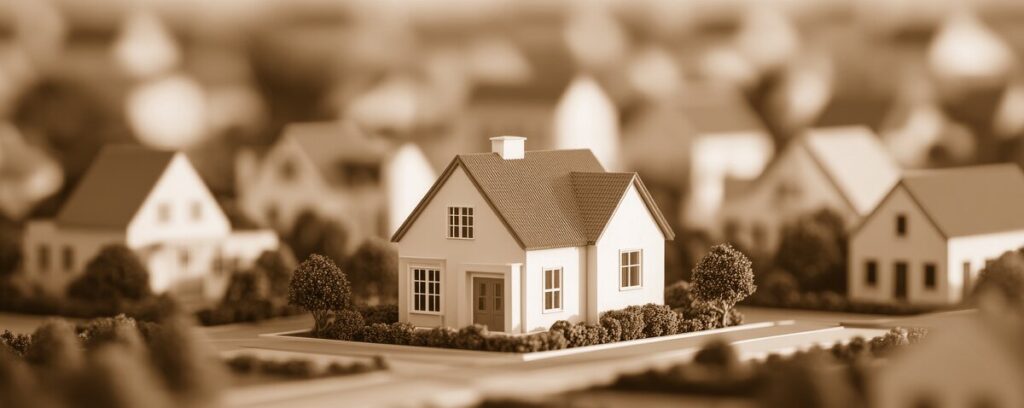
A Neighborhood Born from Naperville’s Southward Growth
Harmony Grove sits in southern Naperville, just north of 111th Street and east of Route 59, near Book Road and the Will County line. Today, it is known for its large homes, tree-lined streets, ponds, sidewalks, and welcoming residential atmosphere. But unlike downtown Naperville’s historic neighborhoods, Harmony Grove is a relatively young community—one that reflects the city’s dramatic suburban growth during the late 20th century.
Most homes in Harmony Grove were built between approximately 1995 and 2001, as Naperville expanded into former agricultural land south of the older city limits. Real-estate records identify the community as a single-family subdivision developed during that period, while neighborhood materials describe nearly 400 homes arranged around two ponds and shared open spaces.
For longtime residents, the neighborhood’s story is part of a larger Naperville transformation. The city began as Joseph Naper’s settlement beside the DuPage River in 1831 and remained a small, largely rural community for decades. Rail service arrived in 1864, helping Naperville grow into a regional center. Much later, postwar development, new highways, expanding schools, and employment opportunities pushed residential construction beyond the traditional downtown core and eventually into the southern part of the city.
How Harmony Grove Got Its Name
Harmony Grove does not appear to be the name of an old village, farmstead, or historic settlement that predates the subdivision. Instead, the name seems to have been selected as part of the community’s late-1990s development identity. Public neighborhood materials do not identify a specific individual or event responsible for the name.
Still, “Harmony Grove” captures the character the builders wanted to create. “Harmony” suggests a peaceful, coordinated residential setting, while “grove” evokes trees, shade, and a connection to the open landscape that once covered southern Naperville. The name also fits the neighborhood’s physical design: streets curve through clusters of homes, common areas soften the edges of the development, and ponds provide natural focal points.
That naming tradition is familiar in Naperville. Many subdivisions use names associated with nature, pastoral landscapes, history, or community ideals. In Harmony Grove, the name helps distinguish the neighborhood from the busy commercial corridors along Route 59 while suggesting a quieter place just beyond them.
Building the Community in the 1990s
Harmony Grove took shape during one of the most important periods in modern Naperville history. By the 1990s, the city was no longer simply a small railroad town west of Chicago. It had become a major suburban community with expanding public schools, new employment centers, transportation links, and neighborhoods stretching south toward 111th Street.
The subdivision’s homes were designed for the expectations of that era. Many are spacious two-story residences with traditional or New Traditional influences, generous lots, attached garages, front-facing windows, and individualized exterior details. Although the houses share a common architectural vocabulary, the neighborhood has never felt entirely uniform. Different elevations, landscaping choices, patios, mature trees, and pond views give individual streets their own personality.
Several streets help define the neighborhood’s identity, including Fesseneva Lane, Freeland Circle, Fairhauser Road, Clearwater Lane, Mather Drive, Niswender Drive, Chokeberry Drive, and Haviland Court. Their winding layouts and cul-de-sacs reflect the suburban planning style of the period, designed to slow traffic and create a more residential, neighborly environment.
Kendall Elementary and the Meaning of Place
One of Harmony Grove’s most important landmarks is Oliver Julian Kendall Elementary School at 2408 Meadow Lake Drive. The school opened in 1998, just as Harmony Grove and nearby southern Naperville communities were filling with young families. Its location beside the neighborhood helped make the area especially attractive to homeowners with elementary-age children.
Kendall Elementary also connects Harmony Grove to Naperville’s older history. The school honors Oliver Julian “Judd” Kendall, a Naperville native and World War I lieutenant who was captured and killed in France. Kendall’s story gives an otherwise modern school a strong historical identity, and the school’s patriotic colors and Patriots mascot reinforce that connection.
Walking routes along Meadow Lake Drive, Pradel Drive, Wicklow Road, Ayrshire Court, and nearby streets bring the school into the daily life of the neighborhood. For many families, the trip to Kendall has been a child’s first independent walk, a place to meet lifelong friends, and one of the earliest ways residents feel rooted in Harmony Grove.
Pradel Park and Community Life
Just beside Kendall Elementary is George A. Pradel Park, a central recreational landmark for Harmony Grove and surrounding neighborhoods. The park includes soccer fields, baseball and softball areas, a playground, trails, open lawn, and picnic space. It was dedicated in 1999 in honor of George Pradel, who served as Naperville’s mayor from 1995 to 2015 and later became known as mayor emeritus.
Pradel Park is more than a collection of athletic fields. It is the neighborhood’s shared backyard—a place for school games, weekend practices, birthday gatherings, dog walks, and the casual conversations that turn nearby homeowners into neighbors. Its presence also reflects a major planning principle of modern Naperville: residential growth was paired with schools, parks, sidewalks, and public amenities rather than left as a collection of isolated subdivisions.
The ponds within Harmony Grove play a similar role. They are not historic millponds or remnants of an early settlement, but they have become recognizable visual landmarks. Over time, their edges have matured with landscaping and trees, giving the neighborhood a softer, more established appearance than it had when the first homes were completed.
From New Subdivision to Established Community
In its early years, Harmony Grove was a neighborhood of construction crews, newly planted trees, moving trucks, and families arriving from other parts of Chicagoland and beyond. Children grew up together, schools expanded to accommodate enrollment, and residents gradually transformed a former farm landscape into a settled community.
Today, Harmony Grove feels less like a new development and more like one of southern Naperville’s established neighborhoods. Many original homeowners have remained for decades, while younger families and longtime Naperville residents have moved into homes that have been updated, remodeled, and carefully maintained. The landscaping has matured, the trees now frame the streets, and the once-new ponds have become familiar gathering points.
Harmony Grove’s heritage is therefore not based on antique buildings or centuries-old streetscapes. Its heritage is the story of modern Naperville: farmland becoming homes, schools arriving alongside families, and a planned subdivision developing a genuine sense of belonging. From Fesseneva Lane to Meadow Lake Drive, from the ponds to Pradel Park, Harmony Grove has grown into a place with its own traditions and memories.
That is what makes the neighborhood special. Its history is young, but it is already deeply lived.